
MY FAVORITE ARTISTS: INTERPRETIVE CRITIQUE NO. 2

This is the second blog in my series on my favorite artists. We will focus on iconic American artist, Thomas Eakins (1844-1916). From an operating table to Arcadia, psychological portraits to sculling, Eakins had a knack for laying bare his subjects’ deepest emotions and frailties by using a ground-breaking hyper-realist technique.

Max Schmitt in a Single Scull, Thomas Eakins, 1871, oil on canvas
Source: Metropolitan Museum of Art, NYC
In Max Schmitt in a Single Scull, Eakins shows us a single resting rower in the foreground, while he portrays himself rowing in the second scull in the middle ground. The painting was produced by Eakins to commemorate Schmitt’s win in an 1870 single sculls competition. The earthy palette and realistic perspective serve as a backdrop for the resting rower, Max Schmitt. He looks directly at the viewer with a resigned look of contemplation, perhaps ruminating over the value of sculling within his big picture life. This image illustrates Eakins’ interest in science, from the physics of rowing to the engineering of the bridges in the background. He contrasts a resting scull with a kinetic one, and shows the Girard Avenue Bridge and Pennsylvania Railroad Connecting Bridge over the Schuykill River in detail, reminding us of the engineering skill that went into building them.
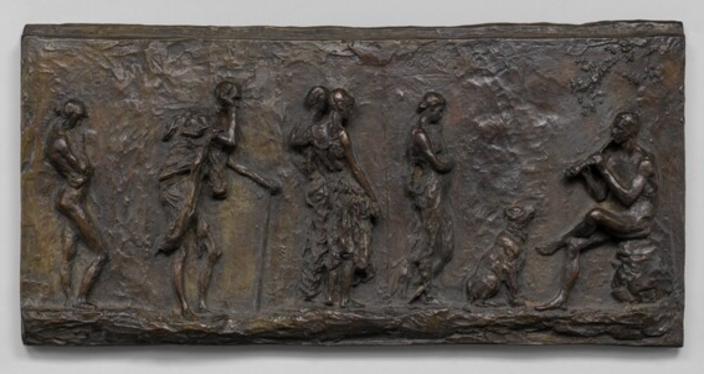
Arcadia, Thomas Eakins, 1883, bronze
Source: Hirshhorn Museum & Sculpture Garden, Washington, DC
Eakins’ Arcadia reliefs serve to evoke a longing to return to a former idyllic time, away from the grime and turmoil of industrialism in the modern age (late 19th century). Arcadia had long been celebrated by European artists as a pristine and symbiotic natural retreat. Eakins’ reliefs are part of the late 19th century movement by certain American artists and writers to escape the stress and chaos of the modern world to a utopian retreat free of worries (termed by T.J. Jackson Lears as “anti-modernism” ).

The Gross Clinic, Thomas Eakins, 1875, oil on canvas
Source: Philadelphia Museum of Art
In The Gross Clinic, Eakins depicted Philadelphia’s famous surgeon and teacher, Dr. Samuel Gross, operating in Jefferson Medical College’s surgical amphitheater. Dr. Gross performs surgery on the left thigh of a patient during a clinic, while five doctors look on. Eakins painted himself sketching in the background. On the left side of the painting, a woman covers her eyes in horror (she is thought to be Dr. Gross’ mother), infusing the painting with gender dynamics: what is the proper place for a woman? The realism of this work caused the 1876 Philadelphia Centennial’s art jury, for whom he painted the piece, to reject it, possibly due to its unflinching depiction of bloody fingers and scalpel, and yawning incision. Some viewers and critics recoiled from the painting, longing for the noble subject matter and perfect aesthetics of high European art.

The Artist’s Wife & His Setter Dog, Thomas Eakins, c. 1884-1889, oil on canvas
Source: Metropolitan Museum of Art, NYC
Eakins portrays his wife, Susan Hannah Macdowell, and setter dog in a portrait so realistic it is disarming. Her face has prominent bags under the eyes, red and swollen eyelids and skin blemishes, as if she had just been crying deeply. An illustrated book sits in her lap, her hands frozen in a position of just letting go. The hem of her dress becomes part of the floor and her arm, with its almost ninety degree bend, mirrors the profile of the chair itself, as if she is also a piece of furniture. Her huge and penetrating eyes stare down the viewer, challenging him/her to ask her why she is in this suspended state. She could be reading, or petting the dog, or sewing, or anything, but instead is lost in a contemplation so intense, she may evaporate at any moment. It is this sense of being caught between stagnancy and flux, the inside and outside, that Eakins so perfectly realizes in this painting. Thomas Wilmer Dewing, around thirty years later, crystalized this same moment in his Green and Gold.

Green & Gold, Thomas Wilmer Dewing, by 1917
Source: Metropolitan Museum of Art, NYC

Portrait of Mrs. Thomas Eakins, Thomas Eakins, c. 1899, oil on canvas
Source: Hirshhorn Museum & Sculpture Garden, Washington, DC
Eakins’ portrait of his wife, Susan, continues this bent of hyper realism within his oeuvre. Susan is shown with that piercing stare directly at the viewer. Her face has wrinkles and bags, far from the idealizing trend so common within the tradition of portraiture. In this moment, she is laid bare. She, also a professionally-trained painter, has an inner realization. Not the heroically ideal male or perfectly beautiful female, but who she really is, for better or worse

Portrait of Mrs. Helen MacKnight, Thomas Eakins, c. 1903, oil on canvas
Source: Hirshhorn Museum & Sculpture Gallery, Washington, DC
Perhaps Eakins’ most extreme example of a “psychological portrait” is this depiction of Mrs. Helen MacKnight. Her eyes are so electric they look as if they might pop from her head, the swollen circles around them emphasizing their largeness. Her hair is disheveled, mirroring the colors in her plain blouse. The light shining on her face, along with her voltaic eyes, might symbolize an awakening akin to that of Esther or Edna, who had to retreat to oblivion to find realization of the self.

Comments