
My Favorite Artist #4: Bessie Potter Vonnoh


Bessie Potter Vonnoh (1872 – 1955) was an American sculptress remembered for her elegant garden fountains and small-scale bronze domestic subjects. She was born in St. Louis to Alexander and Mary Potter, native Ohioans. By 1877, she was living in Chicago with her mother. Vonnoh enjoyed art at an early age and enrolled in the Art Institute of Chicago in 1886, at age fourteen. The famous American sculptor, Loredo Taft, hired her as his studio assistant to help her pay for her tuition. She studied sculpture with Taft at the Institute from 1890-1891.
Vonnoh, along with Janet Scudder, Helen Farnsworth and others, known as the White Rabbits, helped Taft with the sculptures to adorn the Horticultural Building at the 1893 Chicago World’s Fair. Vonnoh sculpted a work commissioned just for her, Personification of Art, for the Illinois State Building at the Fair.

In 1895, while in Europe, Vonnoh met world-famous sculptor Auguste Rodin. A few years later, she was awarded the important commission for General Samuel Crawford’s bust for the Smith Memorial Arch in Philadelphia. She married Impressionist painter, Robert Vonnoh, in 1899.
Bessie Vonnoh received a bronze medal at the 1900 Exposition Universelle for A Young Mother, and exhibited her statuette, Girl Dancing, there. She went on to exhibit at the 1901 Pan-American Exposition in Buffalo, and the 1904 St. Louis World’s Fair. In Buffalo, she was awarded an honorable mention for A Young Mother, and in St. Louis a gold medal for a group of ten sculptures.

Bessie and Robert, along with a group of other artists, established a studio at 27 West 67th Street in Manhattan in 1903. Later that year, the couple became members of the Olde Lyme Art Colony in Connecticut. Bessie exhibited at the Armory Show in 1915, and, in 1921, was elected an academician of the National Academy of Design. In 1931, she was elected to the American Academy of Arts and Letters. Six years later, Bessie finished her most well-known large-scale sculpture, the Burnett Memorial Fountain, in New York’s Central Park.
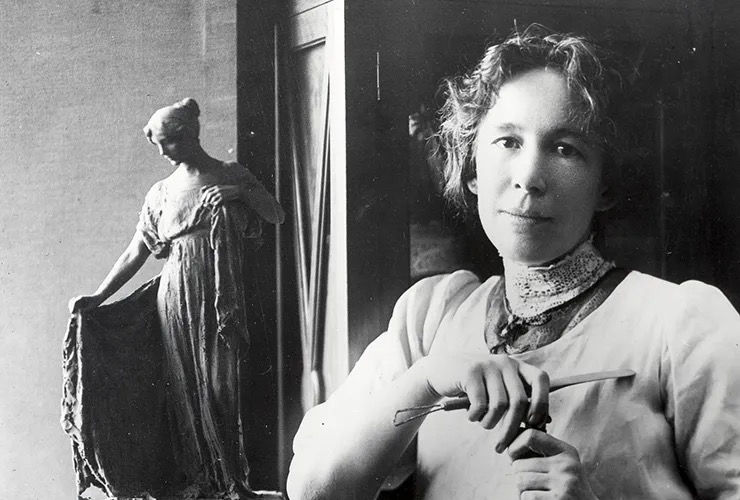
Vonnoh died in 1955 in New York City and is buried in the Duck River Cemetery in Old Lyme. She strove to “look for beauty in the everyday world, to catch the joy and swing of modern American life.” She was “determined to prove that as perfect a likeness and as much beauty could be produced in statuettes twelve inches in height, and in busts of six inches, as could be had in life-size and colossal productions suitable for so few houses.” Her small-scale sculptures, perfect for display in individual homes, evoke powerful emotions associated with everyday life, and many, through a sense of dynamic movement, like billowing dresses and dancer’s moves, engage the viewer in a thrilling rush. Our present existence is shaken mightily by her delicate and ethereal remembrances of the timeless values we hold dear.


Comments